Imagen principal
Dirección
C/ Rua 13
Teléfono
948 82 58 68
Web
https://tudelacultura.com/casa-del-almirante/
Galería de imágenes
Categoría
Ubicación
42.06374, -1.60632
Descripción corta
It is a Renaissance style palace built in the early 16th century.
Descripción larga
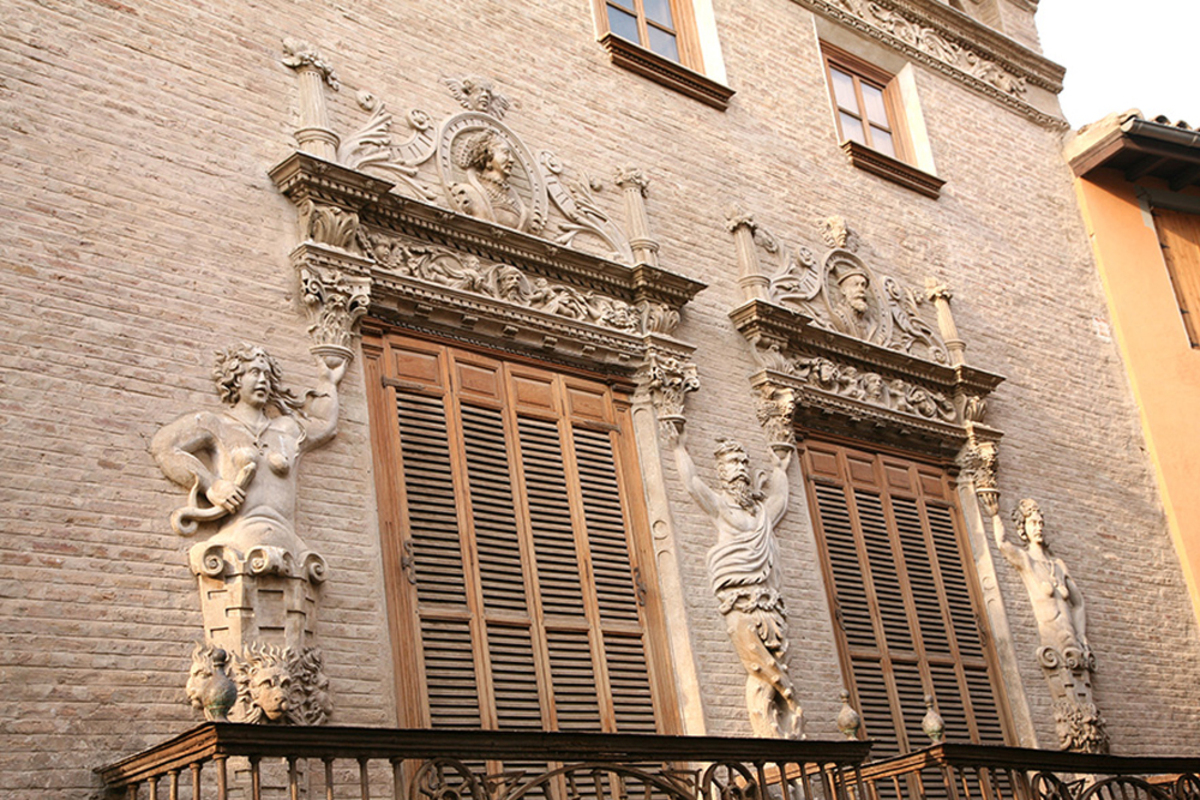
Renaissance palace dated 1520-1560. The façade is divided into three sections, with a gallery of arches and oculi in the upper section crowned by a carved wooden eave. The main floor has balconies decorated with bas-reliefs depicting different figures and candelieri ornamentation, topped by round frames around a female and a male busts. The House of the Admiral is owned by the municipality and is the headquarters of María Forcada Foundation and Tudela-Culture.
It is a Renaissance style palace built in the early 16th century. A bit more ancient than the palace of the Marquis of San Adrián. Its construction took place between 1520 and 1560.
On the outside we see that it is made of brick articulated in three bodies that are topped with a profusely decorated wooden eaves.
The decoration of the façade is mainly concentrated around the original wrought iron balconies of the main floor, whose openings are framed by sculptures in bas-relief based on human figures, in the manner of stipites. They are the representation of Hercules in the center, and on both sides, two women symbolizing vice and virtue.
The lintels have candelieri decorations, Renaissance ornaments in the form of candelabra with human figures, and topped by round frames, one with a female portrait and the other one with a male portrait. Both possibly portraits of the founders of the palace.
The upper body, smaller, contains three linteled windows and is crowned by a continuous frieze with grotesque decoration that mixes geometric and vegetal elements, as well as putti and mascarons.
Above there is a gallery over a plinth that is articulated by pillars and blind oculi on the upper edge of which there are eight double semicircular arches.
The façade is completed by the wooden eaves, which cover the whole building. It was originally profusely painted and it still retains traces of Baroque polychromy that shows vases and flowers.
The first known owners of this Renaissance palace were the Cabanillas Berrozpe family, heirs of the Gómez Peralta family. They were succeeded by the Castillo Cabanillas and Gómez de Peralta in the 17th century, Ximénez de Cascante and Ximénez de Antillón in the 18th century, and the Baron de la Torre in the 19th century.
For more than 40 years the house was owned by Maria Forcada, who carried out several interventions of consolidation and restoration. Today, thanks to her donation, the House of the Admiral is owned by the city of Tudela, headquarters of the Foundation that carries her name and Tudela-Culture.
It is unknown exactly why this house uses the nickname of the Admiral. It might be due to one of the owners, José Ezquerra del Bayo, who belonged to the merchant navy or because of the decoration of the ship's helm of its balconies.
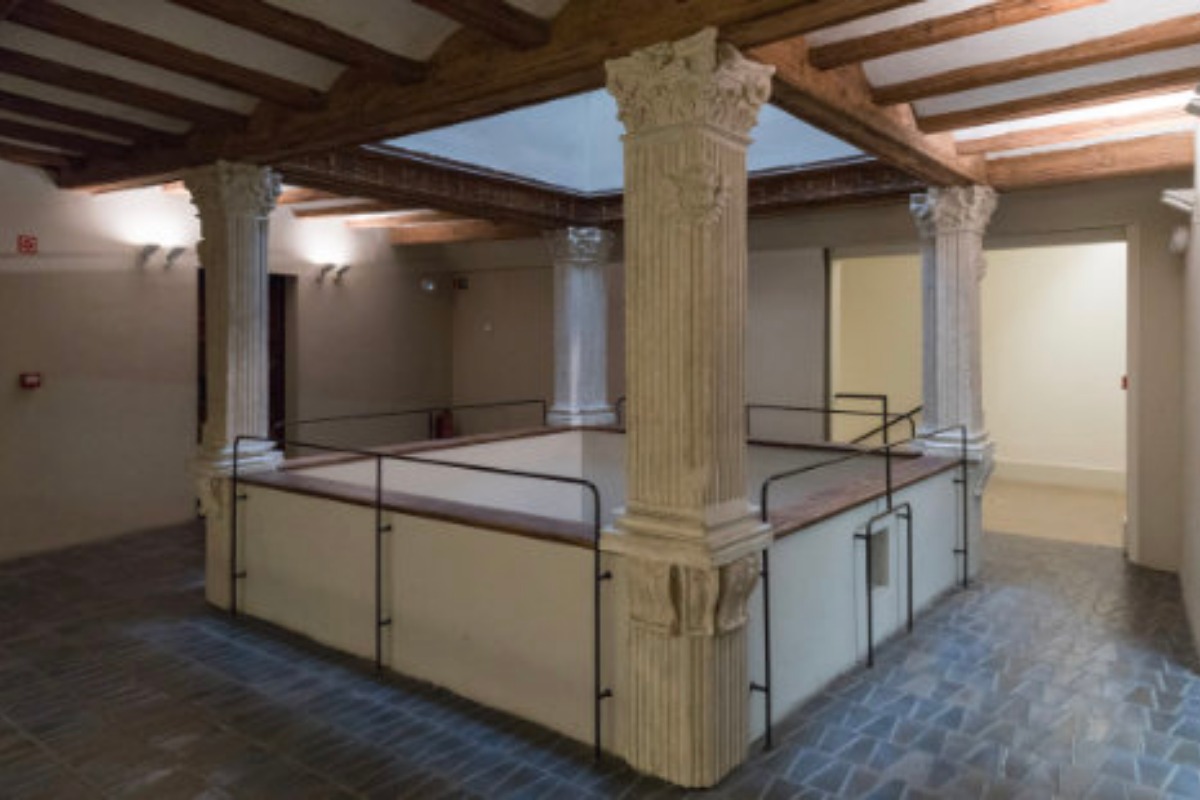
Inside, the central courtyard preserves traces of the old 16th century construction and the original woodwork of some of its doors.
More information: https://fundacionmariaforcada.com/la-casa-del-almirante/
It is a Renaissance style palace built in the early 16th century. A bit more ancient than the palace of the Marquis of San Adrián. Its construction took place between 1520 and 1560.
On the outside we see that it is made of brick articulated in three bodies that are topped with a profusely decorated wooden eaves.
The decoration of the façade is mainly concentrated around the original wrought iron balconies of the main floor, whose openings are framed by sculptures in bas-relief based on human figures, in the manner of stipites. They are the representation of Hercules in the center, and on both sides, two women symbolizing vice and virtue.
The lintels have candelieri decorations, Renaissance ornaments in the form of candelabra with human figures, and topped by round frames, one with a female portrait and the other one with a male portrait. Both possibly portraits of the founders of the palace.
The upper body, smaller, contains three linteled windows and is crowned by a continuous frieze with grotesque decoration that mixes geometric and vegetal elements, as well as putti and mascarons.
Above there is a gallery over a plinth that is articulated by pillars and blind oculi on the upper edge of which there are eight double semicircular arches.
The façade is completed by the wooden eaves, which cover the whole building. It was originally profusely painted and it still retains traces of Baroque polychromy that shows vases and flowers.
The first known owners of this Renaissance palace were the Cabanillas Berrozpe family, heirs of the Gómez Peralta family. They were succeeded by the Castillo Cabanillas and Gómez de Peralta in the 17th century, Ximénez de Cascante and Ximénez de Antillón in the 18th century, and the Baron de la Torre in the 19th century.
For more than 40 years the house was owned by Maria Forcada, who carried out several interventions of consolidation and restoration. Today, thanks to her donation, the House of the Admiral is owned by the city of Tudela, headquarters of the Foundation that carries her name and Tudela-Culture.
It is unknown exactly why this house uses the nickname of the Admiral. It might be due to one of the owners, José Ezquerra del Bayo, who belonged to the merchant navy or because of the decoration of the ship's helm of its balconies.
Inside, the central courtyard preserves traces of the old 16th century construction and the original woodwork of some of its doors.
More information: https://fundacionmariaforcada.com/la-casa-del-almirante/
Destacado
Desactivado