Imagen principal
Dirección
Plaza de los Fueros
Galería de imágenes
Categoría
Ubicación
42.06162, -1.60574
Descripción corta
Main Square of the city, known as New Square or Square of the Fueros, the historically Municipal Charters conceded to Navarre.
Descripción larga
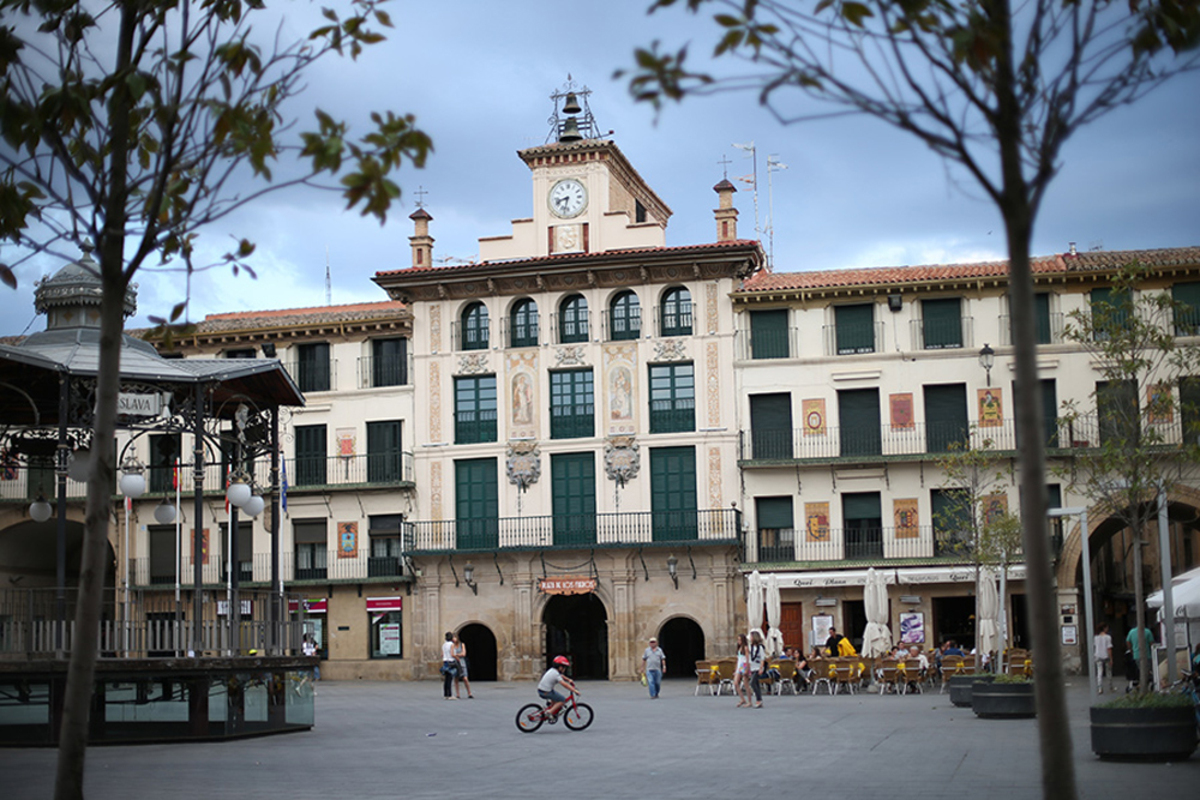
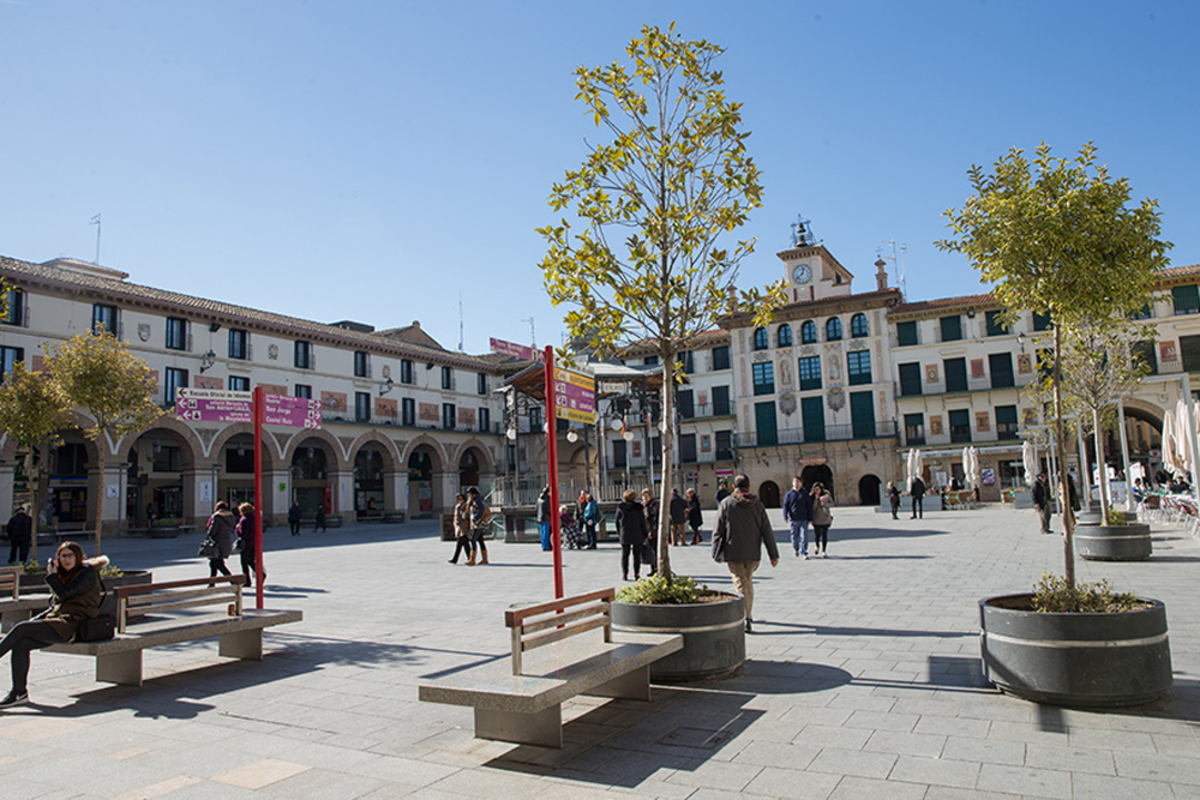
This 17th-century urban design, which covers the Queiles River, is characterized by its regularity, simplicity and symmetry. The Clock House stands out on the southwest side.
Its origin was to be a bullring, hence the bullfighting scenes that adorn part of the tiles in the square. The rest of the ceramics represent the towns of the region of Tudela and heraldic emblems of illustrious families from Tudela.
The Main Square, heart of Tudela, and neuralgic center of the celebrations in the city, has been known throughout its history with diverse names, being called in its beginnings "The Bull Ring", by its original function until 1841, "Royal Square", during the French domination, "Constitution Square", "of Ferdinand VII", "of The Republic", "New" and, from 1893, " Square of the Municipal Charter".
It was built between 1687 and 1691 by the master builders Juan de Lazcano, José Ezquerra and Domingo Ucazcal. Its creation is given by the need for a large space in which to hold bullfights and other civic-religious spectacles of the city. It represents the opening of the medieval walled city, giving way to a more modern city. For this it was necessary to cover the river Queiles by means of a "canyon" or stone arch that would later be filled with earth to serve as the floor of the square itself, needing to break the the wall and the Albazares gate.
The model follows the urban layout promoted in Spain by the Habsburgs, with a regular and symmetrical layout, presenting a semi-enclosed quadrangular space, very similar to the Main Square of Madrid or Valladolid.
The elevation is composed of four structures of linteled openings: the first floor had an arched covered portico, which no longer exists. In the second and third floors, we find wide balconies for viewing the shows and in the fourth, balconies without ledge. All of them with iron balustrades and polychromed in red, nowadays in green color.
It was mandatory to build all the buildings in the square symmetrically, only the house of the Clock stands out.
House of the Clock:
In the center of the southwest side of the square stands the "House of the Clock" or "of the City", originally used by the aldermen to watch the bullfights, known as the "Balcony of Bulls". It was built by Domingo Ucazcal himself and the master architect and sculptor Pedro Viñés, who was in charge of the carpentry of the building.
It is a rectangular wall elevated to three floors: the lower floor is made of stone and has a triple arched entrance, the second floor has three balconies with shelves and ironwork, the second floor has three balconies without shelves and, as a finishing touch, a gallery of round arches crowned by a wooden eave. We see two coats of arms of the city of Tudela, made by the master gilder Francisco Arregui.
The decoration of neoclassical painting is dated later on, in 1859, by the painters José Base and Patricio Andrés.
In 1885 it was decided to place a clock inside a neoclassical temple in the highest part of the House of the City because those that existed in the tower of the cathedral and the City Hall "were very inaccurate", thus acquiring this way its current name.
Ceramics and coats of arms
On the second and third floors of the square we find ceramics that were placed between 1966 and 1971, with the representation of the heraldic emblems in stone and ceramics of illustrious surnames from Tudela and the towns of Tudela region, as well as nine ceramic paintings of bullfighting themes based on the "Bullfighting of Goya" installed on the façade of the old Hospital.
Three of the heraldic emblems attached to the House of the Clock belong to the 18th century, the work of Anselmo Jiménez Blanco. The first, by the Sesma Lahortiga family, is baroque and has a split interior with an eagle over a heart with seven bucklers and a tree with a wild boar. The second, rococo from the second half of the 18th century, shows the arms of the Marín family. Of the same period is the third one that shows the arms of Petriz de Cruzat Sarasa. Two coats of arms of the city were also added with explanatory cards executed by the master gilder Francisco Arregui.
Kiosk
In the center of the square a fountain known as the "Big Angels" from London was installed in 1885. It is formed by a circular tray at the bottom, and with four children carrying barrels from which the water came out and two trays on their heads by which the water cascaded. It was replaced by the current kiosk in 1921, a project commissioned to Nicasio Martínez and the artistic ironwork to the master locksmith and blacksmith Santiago Marsellá.
In 2004, the kiosk was renovated, and its structure was modernized.
It is a space destined fundamentally to the music, because here is where pipers and the Municipal Band plays during the patron saint festivities and the popular "Revoltosa" dance. This festivity consists in dancers going round in circles very fast and around the kiosk following the sound of the music of the pipes.
Church of Saint Mary (Former Hospital of Our Lady of Grace)
The façades of the Church and the Hospital of Our Lady of Grace, founded by Mr. Miguel de Eza y Veráiz in 1549, were remodeled and integrated into the square on one of its four sides, giving uniformity to the urban space. An important modification took place in 1941 with the incorporation of porches on the lower floor to achieve greater amplitude.
Its origin was to be a bullring, hence the bullfighting scenes that adorn part of the tiles in the square. The rest of the ceramics represent the towns of the region of Tudela and heraldic emblems of illustrious families from Tudela.
The Main Square, heart of Tudela, and neuralgic center of the celebrations in the city, has been known throughout its history with diverse names, being called in its beginnings "The Bull Ring", by its original function until 1841, "Royal Square", during the French domination, "Constitution Square", "of Ferdinand VII", "of The Republic", "New" and, from 1893, " Square of the Municipal Charter".
It was built between 1687 and 1691 by the master builders Juan de Lazcano, José Ezquerra and Domingo Ucazcal. Its creation is given by the need for a large space in which to hold bullfights and other civic-religious spectacles of the city. It represents the opening of the medieval walled city, giving way to a more modern city. For this it was necessary to cover the river Queiles by means of a "canyon" or stone arch that would later be filled with earth to serve as the floor of the square itself, needing to break the the wall and the Albazares gate.
The model follows the urban layout promoted in Spain by the Habsburgs, with a regular and symmetrical layout, presenting a semi-enclosed quadrangular space, very similar to the Main Square of Madrid or Valladolid.
The elevation is composed of four structures of linteled openings: the first floor had an arched covered portico, which no longer exists. In the second and third floors, we find wide balconies for viewing the shows and in the fourth, balconies without ledge. All of them with iron balustrades and polychromed in red, nowadays in green color.
It was mandatory to build all the buildings in the square symmetrically, only the house of the Clock stands out.
House of the Clock:
In the center of the southwest side of the square stands the "House of the Clock" or "of the City", originally used by the aldermen to watch the bullfights, known as the "Balcony of Bulls". It was built by Domingo Ucazcal himself and the master architect and sculptor Pedro Viñés, who was in charge of the carpentry of the building.
It is a rectangular wall elevated to three floors: the lower floor is made of stone and has a triple arched entrance, the second floor has three balconies with shelves and ironwork, the second floor has three balconies without shelves and, as a finishing touch, a gallery of round arches crowned by a wooden eave. We see two coats of arms of the city of Tudela, made by the master gilder Francisco Arregui.
The decoration of neoclassical painting is dated later on, in 1859, by the painters José Base and Patricio Andrés.
In 1885 it was decided to place a clock inside a neoclassical temple in the highest part of the House of the City because those that existed in the tower of the cathedral and the City Hall "were very inaccurate", thus acquiring this way its current name.
Ceramics and coats of arms
On the second and third floors of the square we find ceramics that were placed between 1966 and 1971, with the representation of the heraldic emblems in stone and ceramics of illustrious surnames from Tudela and the towns of Tudela region, as well as nine ceramic paintings of bullfighting themes based on the "Bullfighting of Goya" installed on the façade of the old Hospital.
Three of the heraldic emblems attached to the House of the Clock belong to the 18th century, the work of Anselmo Jiménez Blanco. The first, by the Sesma Lahortiga family, is baroque and has a split interior with an eagle over a heart with seven bucklers and a tree with a wild boar. The second, rococo from the second half of the 18th century, shows the arms of the Marín family. Of the same period is the third one that shows the arms of Petriz de Cruzat Sarasa. Two coats of arms of the city were also added with explanatory cards executed by the master gilder Francisco Arregui.
Kiosk
In the center of the square a fountain known as the "Big Angels" from London was installed in 1885. It is formed by a circular tray at the bottom, and with four children carrying barrels from which the water came out and two trays on their heads by which the water cascaded. It was replaced by the current kiosk in 1921, a project commissioned to Nicasio Martínez and the artistic ironwork to the master locksmith and blacksmith Santiago Marsellá.
In 2004, the kiosk was renovated, and its structure was modernized.
It is a space destined fundamentally to the music, because here is where pipers and the Municipal Band plays during the patron saint festivities and the popular "Revoltosa" dance. This festivity consists in dancers going round in circles very fast and around the kiosk following the sound of the music of the pipes.
Church of Saint Mary (Former Hospital of Our Lady of Grace)
The façades of the Church and the Hospital of Our Lady of Grace, founded by Mr. Miguel de Eza y Veráiz in 1549, were remodeled and integrated into the square on one of its four sides, giving uniformity to the urban space. An important modification took place in 1941 with the incorporation of porches on the lower floor to achieve greater amplitude.
Destacado
Desactivado