Imagen principal
Dirección
Plaza Mercadal 7, 31500 Tudela ( Navarra )
Categoría
Ubicación
42.06329, -1.6073
Descripción corta
Old school of Saint Andrew.
Descripción larga
It was the church of the Jesuits until their expulsion in 1767; from then on it became the property of the crown and was titled to Saint George the Royal.
Baroque construction of the 17th century, it was renovated inside in the mid-18th century, highlighting a magnificent baroque altarpiece that presides over the altar with the sculpture of St. George.
On the exterior of its brick façade, the front is decorated with vegetal forms and an alabaster coat of arms of the King Charles III.
This church was built in 1608 as part of the convent complex for the Society of Jesus that was installed in Tudela eight years earlier. The church was built following the architectural models established by the Society, whose reference was established in the 16th century in the Church of the Gesù in Rome. We do not know the name of the architect who designed the church, although Juan González de Apaolaza is mentioned, a master who was already contracted in 1608.
The exterior of the brick façade features the front decorated with vegetal forms and an alabaster shield with the coat of arms of King Charles III. In 1767 the Jesuits were expelled from Spain and had to abandon their convents. Two years later, Charles III issued a royal decree converting this church into the parish of Saint George the Royal. Hence the existence of the coat of arms.
In its interior the construction presents a great central nave of three sections to which there are also three chapels on each side communicated between them, besides a wide transept and an outstanding dome. The roofs are of barrel vault with lunettes, except in the central section, that of the vault, which rests on pendentives and in the chapels that use groin vaults, except in the chapel of the Immaculate that uses vault of elliptical half orange, probably fruit of some restoration during the 18th century.
In these years of the middle of the 18th century, some architectural and decorative restorations were undertaken in order to adapt the mannerist elements of the interior to the baroque style of the time, such as the pilasters with composite capitals and the cornice that runs around the perimeter of the church, ornamented with plasterwork, the transept and the chancel. In addition, in 1771 the choir was built at the foot of the building and the pendentives of the dome were ornamented with sculptures. Also at this time, the fresco paintings of the dome of the Chapel of the Immaculate Conception were made.
Saint George, the patron of the church presides the main altarpiece. It was built in 1749 by José and Antonio del Río, two artists from Tudela. Of late baroque style with initial elements of rococo, the Solomonic columns stand out in its outline of great dynamism.
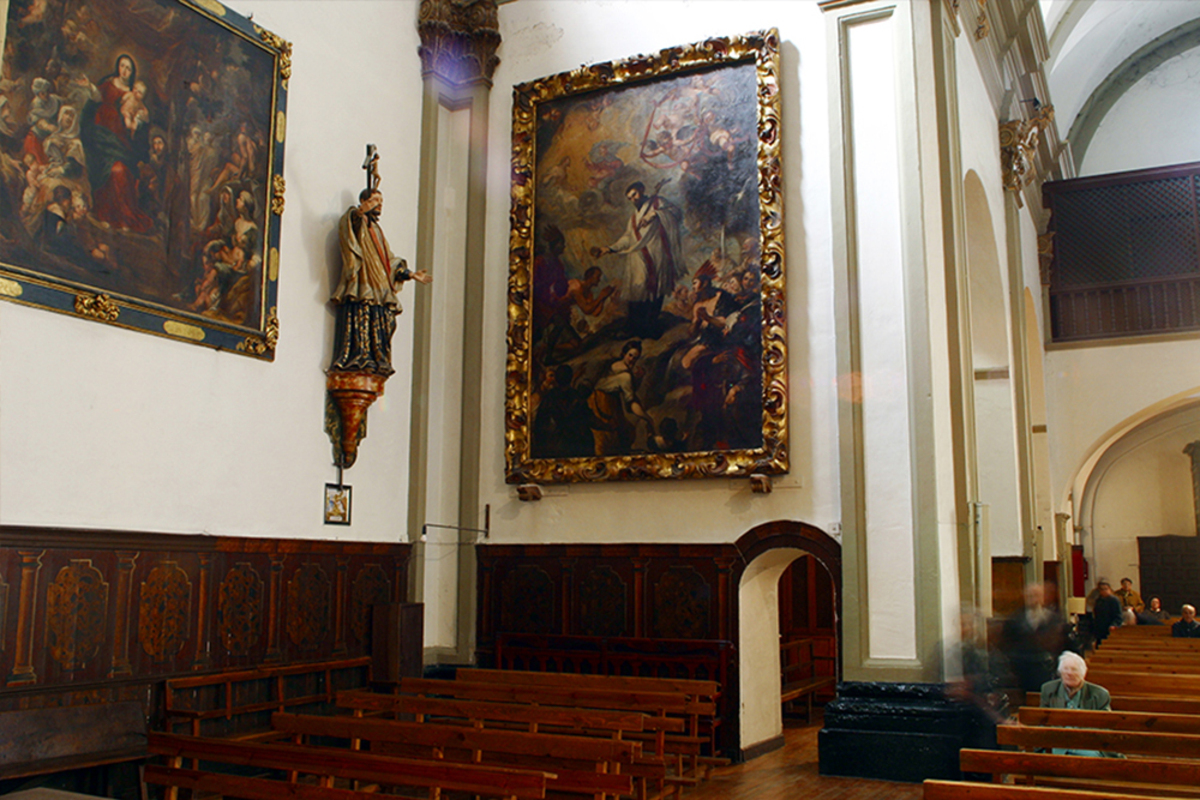
Also noteworthy is the canvas depicting the "Conversion of St. Paul" in the baroque altarpiece dedicated to the saint in one of the chapels and another large canvas of "St. Francis Xavier baptizing", both paintings by the famous baroque painter Vicente Berdusán.
Baroque construction of the 17th century, it was renovated inside in the mid-18th century, highlighting a magnificent baroque altarpiece that presides over the altar with the sculpture of St. George.
On the exterior of its brick façade, the front is decorated with vegetal forms and an alabaster coat of arms of the King Charles III.
This church was built in 1608 as part of the convent complex for the Society of Jesus that was installed in Tudela eight years earlier. The church was built following the architectural models established by the Society, whose reference was established in the 16th century in the Church of the Gesù in Rome. We do not know the name of the architect who designed the church, although Juan González de Apaolaza is mentioned, a master who was already contracted in 1608.
The exterior of the brick façade features the front decorated with vegetal forms and an alabaster shield with the coat of arms of King Charles III. In 1767 the Jesuits were expelled from Spain and had to abandon their convents. Two years later, Charles III issued a royal decree converting this church into the parish of Saint George the Royal. Hence the existence of the coat of arms.
In its interior the construction presents a great central nave of three sections to which there are also three chapels on each side communicated between them, besides a wide transept and an outstanding dome. The roofs are of barrel vault with lunettes, except in the central section, that of the vault, which rests on pendentives and in the chapels that use groin vaults, except in the chapel of the Immaculate that uses vault of elliptical half orange, probably fruit of some restoration during the 18th century.
In these years of the middle of the 18th century, some architectural and decorative restorations were undertaken in order to adapt the mannerist elements of the interior to the baroque style of the time, such as the pilasters with composite capitals and the cornice that runs around the perimeter of the church, ornamented with plasterwork, the transept and the chancel. In addition, in 1771 the choir was built at the foot of the building and the pendentives of the dome were ornamented with sculptures. Also at this time, the fresco paintings of the dome of the Chapel of the Immaculate Conception were made.
Saint George, the patron of the church presides the main altarpiece. It was built in 1749 by José and Antonio del Río, two artists from Tudela. Of late baroque style with initial elements of rococo, the Solomonic columns stand out in its outline of great dynamism.
Also noteworthy is the canvas depicting the "Conversion of St. Paul" in the baroque altarpiece dedicated to the saint in one of the chapels and another large canvas of "St. Francis Xavier baptizing", both paintings by the famous baroque painter Vicente Berdusán.
Destacado
Desactivado